By Rebecca Berger, Development Manager
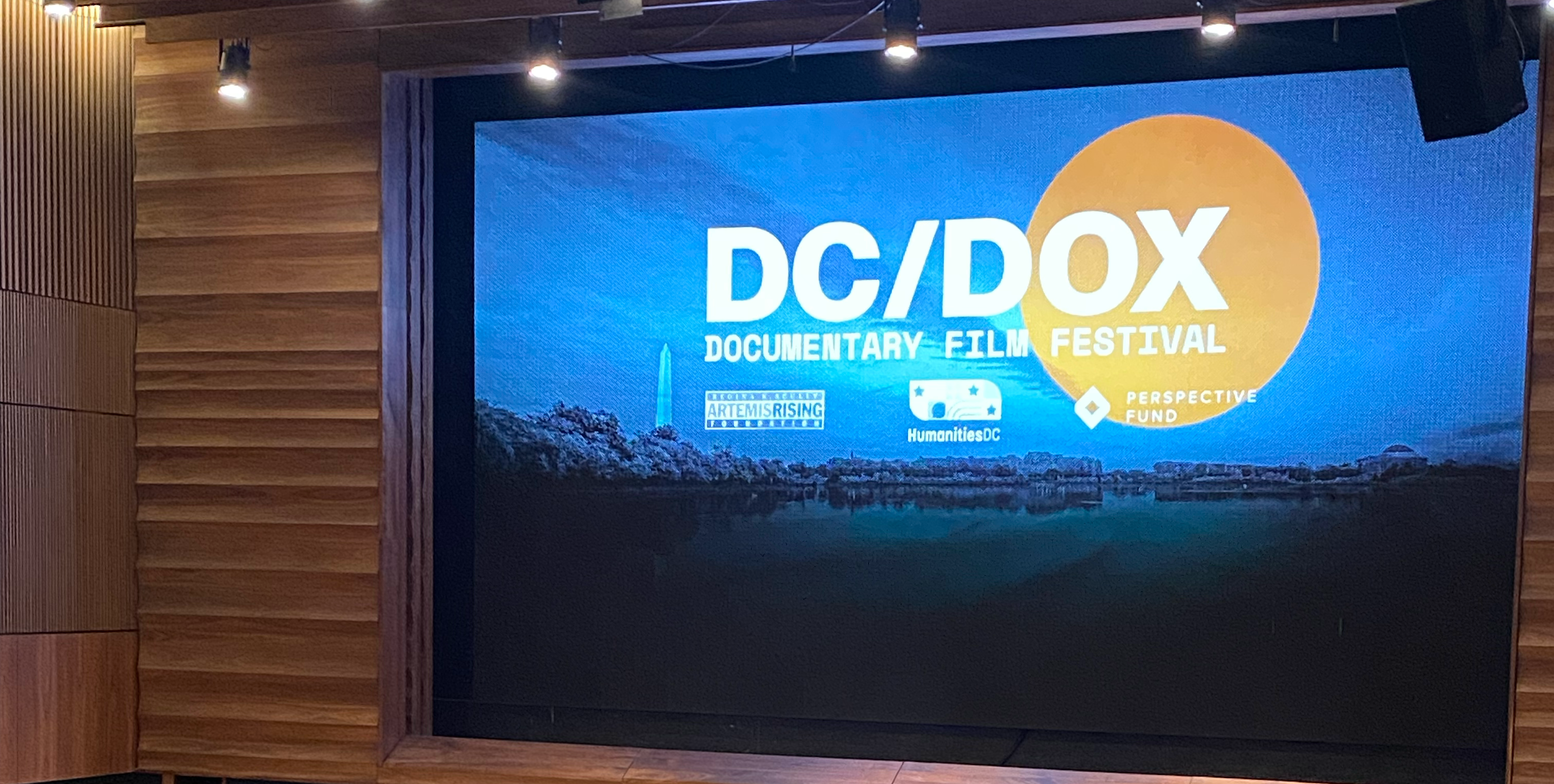
I was drawn to the documentary world by the power of moving images and narratives to meaningfully show how government actions impact people’s everyday lives. That’s because I come from a policy background, having previously worked at an international human rights NGO focused on economic policy. My role as Development Manager at Chicken & Egg Films is my first foray into the documentary ecosystem. In June I attended DC/DOX, the DC documentary film festival, which was an exciting opportunity to immerse myself in the industry and culture of the field. My experience there reinforced why nonfiction storytelling is important—especially when it centers marginalized perspectives. Here’s some of what I observed, learned, and have been reflecting on since my first fest experience as a Chicken & Egg team member.
This year, the dates of DC/DOX coincided with the America 250 UFC fight. The morning before the festival began, I took a walk near the White House. As a history and politics buff, this is something I do every time I visit DC. However, this time, things felt noticeably bleak. I found myself surrounded by fencing and the National Guard. Especially in the context of a documentary festival, it was hard not to think about this as a disturbing sign of the times, a reminder of the democratic backsliding that continues to take place in the US and around the world. With this visceral start to the day under my belt, it was time to see some movies.
Two films directed by Chicken & Egg’s AlumNest stood out to me as especially resonant stories about people who have been failed by the state and are fighting for a better future. The first film was Dawn Porter’s When a Witness Recants, which tells the story of three Black men who were wrongfully incarcerated for the majority of their lives. As teen boys, they were arrested and found guilty of a murder they did not commit. It was only decades later, when a new generation of lawmakers and enforcers who understood systemic injustice came into power, that the men were finally able to prove their innocence. Seeing this passionate chronicle of their decades-long struggle for freedom and justice and the impact of incarceration on their loved ones and community—I was enraged. Before watching the movie, I was already aware that the justice system fails many people by design. But the film still had an extraordinary ability to move me emotionally. I believe this viscerality is the bedrock from which we can envision and act to create a better alternative.
The second film that resonated with me was Leah Galant’s Landscapes of Memory. This film explores the ways governments have co-opted narratives across history to advance their own agendas and goals at the expense of the people they serve. In particular, it hones in on the Israeli government as well as Germany and the US, spotlighting how these nations are leveraging intergenerational Jewish trauma and Holocaust remembrance to justify committing genocide in Palestine. The filmmaker uses her personal experience as a Jew fighting against this harmful co-opting of narrative, memory, and community to show how solidarity offers a path for resisting oppression and building collective liberation. I found myself crying, shaking with anger, and feeling deeply for the people portrayed in this film. As an American Jew myself, what Leah explored in Landscapes of Memory hit close to home.
"I joined Chicken & Egg because I believe that in order to change the system we need more than policy proposals. Documentary films can break the influence of dominant narratives."
But documentary films have that unique ability to capture a spectrum of lived realities and encourage empathy for all. I felt just as deeply for the subjects of When a Witness Recants despite not sharing a similar experience or identity. Both docs showed clearly the ways governments have failed communities and caused them harm—and how these same wronged communities refuse to accept the status quo. These films can serve as powerful vehicles for educating and organizing community members who want to see change. Just as importantly, the documentation and distribution of these stories allows those experiencing similar oppression to know they are not alone.
I joined Chicken & Egg because I believe that in order to change the system we need more than policy proposals. Documentary films can break the influence of dominant narratives. They invite us to envision a better world and take steps to build it. They grow empathy and spark understanding. DC/DOX reaffirmed my career pivot and gave me inspiration, sorely needed during this tough moment on a national and global scale. Now to share some of these films with my friends in policy!